Walsh Pizzi O'Reilly Falanga LLP

Expert legal services specializing in corporate law, pharmaceutical, and criminal defense. Serving clients in New York, New Jersey, Pennsylvania, USA, with a dedicated team for what matters most. Bet the company. Commercial Litigation.

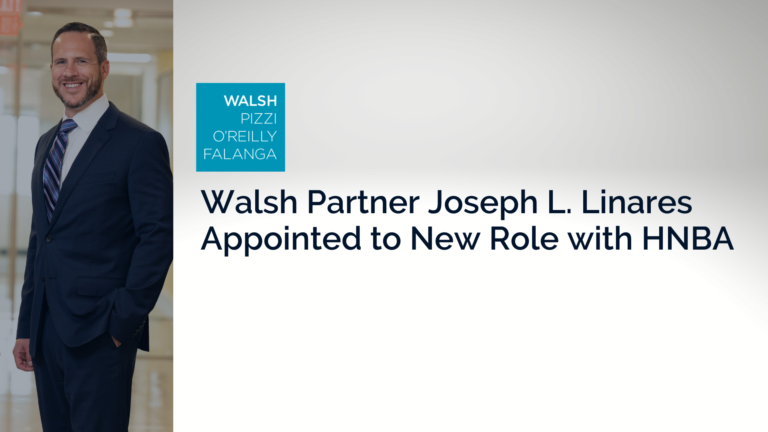
Joseph L. Linares Appointed to New Role with Hispanic National Bar Association

Joseph L. Linares Appointed to New Role with Hispanic National Bar Association 1920 1080 walsh.law

NEWARK, N.J. – Walsh partner Joseph L. Linares has been appointed as one of five inaugural National Affiliate Delegates of the Hispanic National Bar Association (HNBA). Since 2015, Linares has held various leadership positions with the HNBA.

In his new role, Linares will be responsible for coordinating initiatives with various HNBA Affiliates across the country.

“I am honored to accept my appointment by President Mateo for this new, pivotal role,” said Linares. “Over the next two years, I am eager to continue collaborating with others in our shared mission to elevate visibility while fostering inclusivity and diversity in the legal profession.”

Linares is currently an adjunct professor for the MBA program at Seton Hall University Stillman School of Business and serves on the Board of Governors with the Hispanic National Bar Association, Board of Directors with the American Autism Association, is a Trustee at Large with the New Jersey State Bar Association and a Trustee with the Historical Society for the United States District Court for the District of NJ.

About the Hispanic National Bar Association
The Hispanic National Bar Association is an incorporated, not-for-profit, national membership association that represents the interests of over 78,000+ Hispanic attorneys, judges, law professors, legal assistants, law students, and legal professionals in the United States and its territories. Since 1972, the HNBA has acted as a force for positive change within the legal profession by creating opportunities for Hispanic lawyers and by helping generations of lawyers to succeed.


-30-

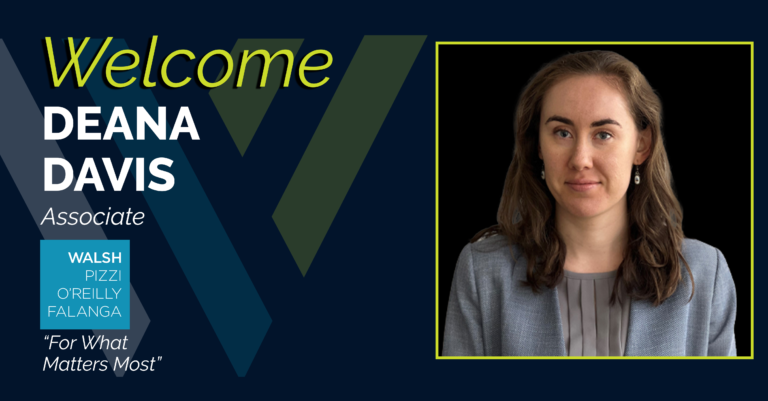
Walsh Welcomes Deana Davis

Walsh Welcomes Deana Davis 5000 2613 Gabby Sully

NEWARK, N.J., – Walsh Pizzi O’Reilly Falanga LLP welcomes Deana Davis to the firm! Deana will be focusing her practice on business and commercial litigation.

Prior to joining Walsh, she clerked for the Honorable Vicki A. Citrino in the New Jersey Superior Court, Passaic Vicinage.

Deana earned her J.D., cum laude, from Rutgers Law School in 2022, where she was the Managing Editor of the Rutgers International Law and Human Rights Journal and a Student Ambassador for the New York City Bar Association. She received her MA (Hons) in Russian Studies and History with distinction in Spoken Russian from The University of Edinburgh.

Six Walsh Partners, One Associate Recognized by Best Lawyers®

Six Walsh Partners, One Associate Recognized by Best Lawyers® 1920 1080 Gabby Sully

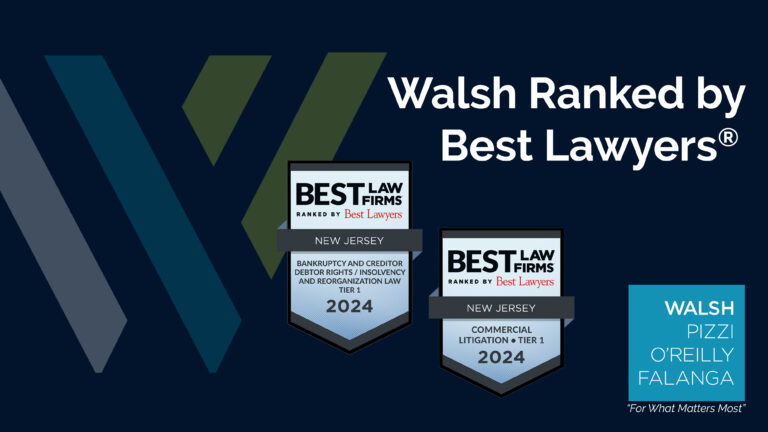
NEWARK, N.J., August 17, 2023 – Walsh Pizzi O’Reilly Falanga LLP is proud to announce that Best Lawyers® has selected six Walsh Partners for inclusion in the 2024 Edition of The Best Lawyers in America®.

Walsh Partners named as Best Lawyers® include:

  • Liza M. Walsh – Bet-the-Company Litigation, Commercial Litigation, Litigation – ERISA, and Litigation – Patent
  • Stephen V. Falanga – Bankruptcy and Creditor Debtor Rights / Insolvency and Reorganization Law
  • Marc D. Haefner – Mass Tort Litigation / Class Actions – Defendants
  • M. Trevor Lyons – Labor Law – Management and Litigation – Labor and Employment
  • Tricia B. O’Reilly – Commercial Litigation and Employment Law – Management
  • Peter J. Pizzi – Commercial Litigation


For the second consecutive year, Associate Jessica K. Formichella has been included in the 2024 edition of Best Lawyers: Ones to Watch® in America for her work in Commercial Litigation, Insurance Law, and Professional Malpractice Law.

Recognition by Best Lawyers® is based entirely on peer review, a consensus opinion of leading lawyers about the professional abilities of their colleagues within the same geographical area and legal practice area. The Best Lawyers in America® was first published in 1983 and publishes top legal talent in more than 70 countries around the world.

###

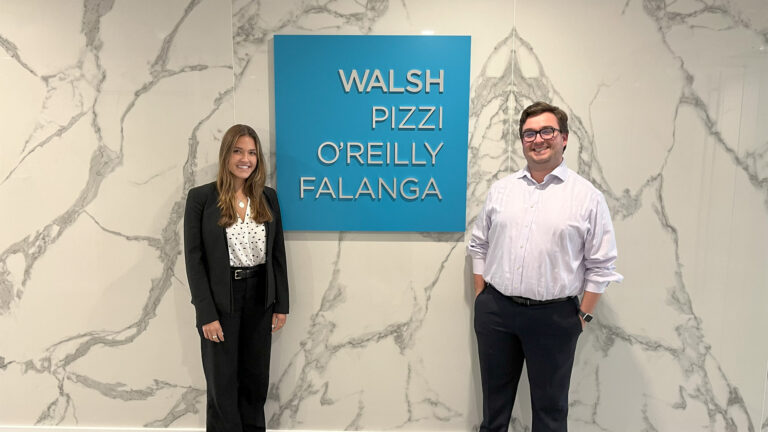
Meet Walsh’s 2023 Summer Associates

Meet Walsh’s 2023 Summer Associates 1920 1080 Gabby Sully

Anthony Koufodontes is a rising 3L student at Seton Hall University School of Law, where has served as treasurer of the Criminal Law Society from 2022-23. He obtained his bachelor’s and master’s degrees in accounting from Hofstra University.

Growing up watching Law & Order led Anthony to take law and legal classes throughout high school and his undergraduate career. During the COVID-19 Pandemic, he felt it was the perfect time to pivot and fulfill a dream of attending law school.

For Anthony, the best part about Walsh is the people, “Everyone so far has been extremely helpful and always willing to explain assignments to ensure I fully grasp something before diving in.”

Anthony is looking forward to his final year of law school, and a future practicing law and engaging in the world he has studied for so long. His interests include antitrust, environmental law, and white-collar and securities litigation.


Natalie Lucciola is a rising 3L student at Seton Hall University School of Law, where she is a Comments Editor for the 48th Volume of Seton Hall’s Legislative Journal. She received a dual degree in economics and communication, with a specialization in public relations from Villanova University, as well as a business minor through the Villanova Summer Business Institute.

As the youngest of four siblings, Natalie wanted to pave her own path and decided to become the first person in her family to pursue law. “When I was in college, I took a Business Law course toward my business minor and really enjoyed the critical thinking and logical reasoning that came with the course,” she explained, “that, coupled with my eagerness to work in a field where I could help others, made it clear that pursuing a career in law was the right path for me.”

Natalie says her favorite part about working at Walsh is the variety of work opportunities and the people. “I knew from the day I interviewed that the culture at Walsh was different. I have had the unique opportunity to work closely with and learn from both partners and associates.” Natalie continued, “For every case I have been assigned to, the associates and partners take the time to properly inform me on the ins and outs of the cases and explain existing case law so that I can effectively complete my assignments. They offer tips to help me improve my research skills while also giving feedback to help me refine my writing skills.”

This year, Natalie is looking forward to being a student attorney for Seton Hall’s FINRA Investor Advocacy Clinic. After graduation, she is looking forward to working directly with clients in various areas of law, as she has been able to do at Walsh.

Walsh’s summer program is coordinated by partners Mariel L. Belanger and Caitlin P. Cascino. As to the success of this summer’s program, Mariel commented, “It was a pleasure to welcome Anthony and Natalie into the Walsh family for the summer. Both were provided with direct exposure to the legal process through attendance at hearings, oral arguments, and depositions and an opportunity to gain tangible legal experience working with partners and associates on a variety of projects across various practice areas. They approached the work with enthusiasm and intellectual curiosity, and we expect they will both find great success in the legal profession in their future careers.”

New Jersey Appellate Division Affirms Dismissal Based Upon Litigation Privilege

New Jersey Appellate Division Affirms Dismissal Based Upon Litigation Privilege 150 150 Gabby Sully


NEWARK, N.J. – Deirdre T. Cooney and Peter J. Pizzi successfully defended a trial court victory in which they obtained pre-discovery dismissal of a lawsuit filed by a lawyer against his former adverse counsel in a prior federal court case. By affirming application of the litigation privilege against such claims, the Appellate Division protected attorneys and their clients from liability based upon motions and arguments made during court proceedings. In response to Law360’s request for comment, Peter Pizzi stated, “We are gratified by the court’s decision affirming the dismissal of this case, which reached the right result.”


The case is Caesar D. Brazza v. Stuart Kagen et al., case number A-1991-21.  More information about this case can be found on Law360.


###


Walsh Associate Francis W. Yook Installed as President of the Asian Pacific American Lawyers Association of New Jersey, Inc.

Walsh Associate Francis W. Yook Installed as President of the Asian Pacific American Lawyers Association of New Jersey, Inc. 1920 1080 Gabby Sully

NEWARK, N.J. – Walsh Pizzi O’Reilly Falanga LLP proudly announces that associate Francis W. Yook has been installed as President of the Asian Pacific American Lawyers Association of New Jersey, Inc (APALA-NJ) for the 2023-24 term.

“I am proud of everything we accomplished last term and remain very excited about the new term. We have some great people returning to the APALA-NJ board, and our new board members are already active and engaged. The board’s expansion from 11 to 15 seats and the considerable number of candidates at our election show that APALA-NJ’s visibility and reach are growing.”

During his time at Brooklyn Law School, Francis was a member of the executive board of the Asian Pacific American Law Students Association (APALSA), where he organized events like the APALSA Alumni Dinner, and volunteered at the Clinton Hill Library for the Neighborhood Theater Project, a literacy and theater program for pre-school and elementary school students. Francis emphasized: “Many of us on the APALA-NJ board have served on an APALSA chapter previously. It’s great experience and in many ways a preview to serving on a board for a larger organization like APALA-NJ

Later this month, APALA-NJ, along with other affinity bar organizations, will be participating in a CLE panel discussion organized by the Administrative Office of the Courts covering an array of topics including diversity, equity, and inclusion in both private and public industry sectors. APALA-NJ is also planning a “Walking Tour” at the Newark Museum of Art, which boasts a sizeable collection of Asian art and antiquities, tentatively scheduled for August 10. APALA-NJ’s Annual Gala and Awards Ceremony is scheduled for September 28.

At Walsh, Francis focuses his practice on commercial and business disputes, product liability, mass tort and multi-district litigation, and other federal and bankruptcy matters. He clerked for Judge Edward Kiel in the United States District Court for the District of New Jersey, and Judge Lisa Firko in the New Jersey Superior Court, Bergen Vicinage. Francis is also Co-Chair of the Diversity in the Profession Committee of the Bergen County Bar Association.

“We are immensely proud of Francis’ installment as President of the APALA-NJ,” said managing partner, Liza Walsh. “His dedication to our clients and passion for creating a positive impact within the community have always been evident in his work. I have no doubt that he will excel in his new role and elevate the APALA-NJ to even greater success.”

The Asian Pacific American Lawyers Association of New Jersey, Inc. is New Jersey’s only Pan-Asian bar association serving Asian American attorneys throughout the state. APALA-NJ, founded in 1985 and incorporated in 1993, is the largest specialty bar association that collectively represents the interests of Asian and Pacific American lawyers in the State of New Jersey. Interested parties can join APALA-NJ by visiting their website. Membership is free for law students and law school graduates not yet admitted to practice.

###

About Walsh Pizzi O’Reilly Falanga LLP
Based in Newark, New Jersey with additional offices located in New York City and Philadelphia, Walsh lawyers strive to provide what matters most to clients: experience, responsiveness, pragmatism, integrity. With over 150 years of combined experience in litigation, compliance and transactional matters, Walsh, a majority women-owned business, is comprised of 30 dedicated, forward-thinking professionals. For more information visit walsh.law.

Walsh Welcomes Patrick Salamea

Walsh Welcomes Patrick Salamea 1200 627 walsh.law

NEWARK, N.J., May 8, 2023 – Walsh Pizzi O’Reilly Falanga LLP welcomes Patrick Salamea to the firm! Patrick will be focusing his practice on business and commercial litigation.

Prior to joining the firm, Patrick served as a law clerk to the Honorable Michael A. Shipp, United States District Judge for the District of New Jersey, and the Honorable Richard J. Geiger of the New Jersey Superior Court, Appellate Division. Prior to joining the firm, Patrick was an associate at Marino, Tortorella & Boyle, P.C.

Patrick earned his J.D. from Seton Hall University School of Law, where he was a Senior Editor of the Seton Hall Law Review. He received his B.S. in Business Management from William Paterson University.

Defense Counsel Journal: The Department of Justice’s Cyber-Fraud Initiative and Its Impact on the False Claims Act

Defense Counsel Journal: The Department of Justice’s Cyber-Fraud Initiative and Its Impact on the False Claims Act 150 150 walsh.law

By Peter Pizzi, Kimberly Bessiere Martin

Download PDF

On October 6, 2021, The Department of Justice (“DOJ”) announced the launch of the Civil Cyber-Fraud Initiative (the “CCFI”), which is designed to combat emerging cyber threats to the security of sensitive information through the use of civil fraud enforcement tools. This initiative proposes to use civil enforcement tools to pursue government contractors who receive federal funds in the event that those contractors fail to meet required cybersecurity standards. The DOJ developed the CCFI as a result of its review of cyber threats with a focus on developing recommendations to combat those threats. At the time of its announcement, Deputy Attorney General Lisa O. Monaco stated that the use of civil enforcement tools was intended to “ensure that taxpayer dollars are used appropriately,” as well as to combat the “mistaken belief that it is less risky to hide a breach than to bring it forward and to report it. . . .”1

The Initiative relies on the False Claims Act (“FCA”)2 to pursue cybersecurity-related fraud by government contractors, grant recipients, and other entities which rely upon federal funding. The FCA, addressed in more detail below, is the main vehicle by which the government addresses false claims for federal funds. In its launch of the CCFI, the DOJ highlighted the FCA’s whistleblower provisions, which allow for a private party who successfully brings forward instances of fraudulent conduct to share in any recovery by the government. The DOJ anticipates that the Initiative will “hold accountable entities or individuals that put U.S. information or systems at risk by knowingly providing deficient cybersecurity products or services, knowingly misrepresenting their cybersecurity practices or protocols, or knowingly violating obligations to monitor and report cybersecurity incidents and breaches.” The DOJ’s use of the FCA as a part of its initiative to combat cyber-threats adds another layer of complexity to an already challenging landscape for companies navigating cybersecurity issues. This article provides an overview of the FCA and discusses recent use in the context of cybersecurity issues.

I.   The False Claims Act

The FCA imposes treble damages and a civil penalty from $12,537 to $25,076 per claim3 on anyone who knowingly submits or causes the submission of a false or fraudulent claim payable by the United States government or related entities.4 In particular, the government has a civil cause of action against any person or entity who:

knowingly presents, or causes to be presented, a false or fraudulent claim for payment or approval;5

knowingly makes, uses, or causes to be made or used, a false record or statement material to a false or fraudulent claim;6

has possession, custody, or control of property or money used, or to be used, by the Government and knowingly delivers, or

causes to be delivered, less than all of that money or property;7

knowingly makes, uses, or causes to be made or used, a false record or statement material to an obligation to pay or transmit money or property to the Government, or knowingly conceals or knowingly and improperly avoids or decreases an obligation to pay or transmit money or property to the Government[;]8 or

conspires to commit [one of these violations].9

Claims for violation of the FCA can be brought by the government or as qui tam actions on the government’s behalf by a private individual, known as a relator.10 Suits brought by relators are often called “whistleblower” suits, and provisions applying to whistleblowers will be discussed in more detail below.

A.   Elements

To state a claim under the FCA, the government generally must make at least four showings by a preponderance of  the  evidence.11 First, the government must establish the existence of a claim actionable under the FCA. Second, the government must establish that the claim was false, either factually or legally.  Third, the government must demonstrate that the falsity was material to the payment of the claim. Finally, the government must establish that the defendant acted with knowledge of the falsity. The following sections provide a brief overview of each requirement for FCA liability.

i.   Claim

The submission of a claim is “the sine qua non of a False Claims Act violation.”12 The FCA broadly defines “claim” as “any request or demand . . . for money or property whether or not the United States has title to the money or property” either (a) “presented to an officer, employee or agent of the United States” or (b) “made to a contractor, grantee or other recipient, if the money or property is to be spent or used on the Government’s behalf or to advance a Government program or interest” and the government has provided or will reimburse for any portion of the money or property requested.13 Entities that routinely receive payment through government programs or contracts—namely government contractors, health care suppliers and providers and financial services companies—are the most likely to find themselves targets of an FCA claim or investigation.

ii.   Falsity

To establish a violation of the FCA, the government must show the existence of a “false or fraudulent claim.”14 A claim may be considered false under the FCA if it is factually or legally false.15 The factually false claim is one “in which a contractor or other claimant submits information that is untrue on its face.”16 A factually false claim generally involves “an incorrect description of goods or services provided or a request for reimbursement for goods or services never provided.”17

In contrast, a legally false claim or certification is one that is “predicated upon a false representation of compliance with a federal statute or regulation or a prescribed contractual term.”18 Courts further divide legally false claims into those claims made legally false by an “express certification” and those claims made legally false by an “implied certification.”19 In an express false certification claim, the claim “falsely certifies compliance with a particular statute, regulation or contractual term, where compliance is a prerequisite to payment.”20 False certification claims based on broad and vague certifications of compliance with law may be found insufficient to give rise to FCA liability.21

An implied false certification claim “is based on the notion that the act of submitting a claim for reimbursement itself implies compliance with governing federal rules that are a precondition to payment.”22 The United States Supreme Court clarified this theory of FCA liability in 2016 in Universal Health Services v. United States ex rel. Escobar.23 In Escobar, the Court held that the “implied certification theory can, at least in some circumstances, provide a basis for liability . . .” and did not require that the government “expressly designated” compliance as a condition  for  payment.24 The circumstances under which this theory may apply, however, were limited by the Court to circumstances where two conditions are satisfied.25 First, a claim must make specific representations about a good or service (as opposed to merely requesting payment). Second, the defendant’s failure to disclose noncompliance with the material statutory, regulatory or contractual requirements makes those specific representations “misleading half-truths.”26

iii.   Materiality

The FCA also requires that false statements be “material” to a false claim. Since the 2009 amendments, materiality has been defined as “having a natural tendency to influence, or be capable of influencing, the payment or receipt of money or property.”27 The Supreme Court also addressed the materiality requirement of the FCA in Escobar by defining it as “demanding.”28 The Court stated that the materiality standard turns on the “likely or actual behavior of the recipient of the alleged misrepresentation.”29 It is not enough for the government or relators to show that “[g]overnment would be entitled to refuse payment were it aware of the violation.”30 The Court did not find that an express designation as a condition of payment was required to state a claim but found this to be relevant to the materiality inquiry.31 The government’s past practices in paying such claims are relevant to the determination.32

While the government and relators may argue that the “materiality” analysis was unaffected by the Escobar decision, many post-Escobar decisions have applied a heightened materiality standard. This heightened scrutiny is resulting in courts requiring more facts supporting materiality to be pled and a closer examination of the government’s actions.33

Since this decision, appeals of adverse verdicts based on Escobar materiality grounds have had success. For example, the Fifth Circuit reversed a $663 million jury verdict in a suit alleging that the defendant had submitted false claims to the government by not disclosing changes to highway guardrails.34 In reaching this result, the court concluded that “continued payment by the federal government after it learn[ed] of the alleged fraud substantially increase[ed] the burden on the relator in establishing materiality.”35 The Escobar materiality requirement is also being raised at the pleading stage under Rule 9(b), with some courts requiring additional facts to be pled on the materiality element or dismissing complaints.36

iv.   Knowledge

To establish a FCA violation, the government must show that the defendant acted “knowingly.” To act “knowingly,” the individual may, but need not, have actual knowledge of the claim’s falsity or have a specific intent to defraud the government.37 Rather, the individual need only “act[] in deliberate ignorance”38 or “in reckless disregard of the truth or falsity of the information.”39 The statute expressly provides that the government is not required to prove that a defendant specifically intended to defraud.40 While Federal Rule of Civil Procedure 9(b) allows knowledge to be alleged “generally,” relators must still plead facts under Rule 8 to support a plausible inference that the Defendants knowingly submitted a false claim.41 General and con-clusory allegations that a defendant “knowingly” submitted false claims, without supporting facts, do not suffice under Rule 8.42

Reckless disregard under the FCA is “an extension of gross negligence or an extreme version of ordinary negligence.”43 As the Supreme Court explained in an analogous context, to show recklessness the government must show that the party’s conduct entailed “an unjustifiably high risk of harm that [was] either known or so obvious that it should [have] be[en] known.”44 The Supreme Court has before it in the 2022-2023 Term a case which involves the application of the reckless disregard standard, which lower courts have said could suffice for FCA liability.45 The law on this precise point could change in the coming months.

Determining whether conduct raises an “unjustifiably high risk” of violating the law depends on a variety of factors. Relevant factors cited by various courts include:

  • the personal knowledge of the defendants and their familiarity with governing legal rules and obligations;46
  • the clarity of existing statutory, regulatory, and contractual guidance addressing the conduct at issue;47
  • the defendant’s justifiable reliance on experts, attorneys, or other entities in making the challenged statements;48
  • the defendant’s compliance with industry practice in taking the challenged actions;49 and
  • the government’s knowledge of or acquiescence towards the challenged conduct.50

b.   Whistleblower Provisions

A private individual, known as a relator, may bring a qui tam action and enforce the FCA on the government’s behalf.51 The relator may be anyone with knowledge of the allegations—such as a current or former employee, a competitor, a customer, or a consultant. When brought by a relator, a complaint is filed under seal and remains unserved on the defendant until the presiding federal court orders otherwise.52 While the complaint is under seal, the government may investigate the relator’s claims and decide whether it will elect to intervene and take responsibility for prosecuting the action or decline to intervene, leaving the relator to litigate his or her  complaint.53 The FCA incentivizes private relators to bring claims by providing them with a share of any proceeds of the action or settlement—15% to 25% if the government intervenes and 25% to 30% if the government does not intervene.54

The government may settle an action brought by a relator, notwithstanding any objection by the relator, “if the court determines, after a hearing, that the proposed settlement is fair, adequate, and reasonable under all the circumstances.”55 The Supreme Court has before it in the 2022-2023 Term the issue whether the government can move to dismiss a FCA action in which it has not intervened and the procedural steps in order for the government to do so.56 The law on this precise point also could change in the coming months.

II.   Application of the FCA to Cybersecurity Issues

Since the start of the CCFI, there have been two reported FCA cyber-fraud settlements. The first occurred in March 2022 and involved the resolution of two whistleblower actions pending in the Eastern District of New York against Comprehensive Health Services  LLC (“CHS”).57 CHS is contracted to provide medical support services at government-run facilities in Iraq and Afghanistan. The government asserted that, under one of the contracts, CHS submitted claims to the State Department for the cost of a secure electronic medical record (EMR) system to store all patients’ medical records. The DOJ alleged that, between 2012 and 2019, CHS billed the State Department $485,866 for storing medical records in a secure system, even though some of the medical records were saved on an internal network drive that was accessible to non-clinical staff. This was asserted to be a direct violation of government contractual requirements. The DOJ alleged that CHS did not take adequate steps to store information exclusively on the EMR system, even after concerns were raised about the privacy of protected information. CHS resolved claims relating to these allegations, and allegations that it falsely represented certain medical supplies as being approved by the FDA or EMA, for $930,000.58

On July 8, 2022, the DOJ reported another settlement involving alleged cybersecurity violations by defense contractor Aerojet Rocketdyne Holdings and Aerojet Rocketdyne Inc. (collectively “Aerojet”), who allegedly failed to comply with requirements in certain federal government contracts.59 The case was watched closely by practitioners in this area. The claim was originally filed by former Aerojet employee Brian Markus – the former senior director of Cybersecurity, Compliance & Controls. Markus alleged that Aerojet knew its cybersecurity programs fell short of Department of Defense and NASA acquisition regulations, which were part of contracts between Aerojet and the agencies.

Despite declining to intervene in the Aerojet case in June 2018, the government filed a statement of interest two weeks after it announced the Civil Cyber-Fraud Initiative, assailing Aerojet’s arguments that it was entitled to summary judgement.60 Notably, the government argued that Aerojet’s contractual deficiencies were a source of damages even if Aerojet otherwise complied with the contracts because “the government did not just contract for rocket engines, but also contracted with [Aerojet] to store the government’s technical data on a computer system that met certain cybersecurity requirements.” The government also argued that assertions that the entire defense industry is not compliant with cybersecurity requirements has no bearing on whether such compliance is material to the government’s payment decision in any particular case.

On February 1, 2022, the United States District Court for the Eastern District of California ruled that the case against Aerojet could proceed on triable issues of fact as to whether noncompliance with government cybersecurity requirements are material to the government’s decisions to approve contracts. The federal court denied Aerojet’s motion for summary judgment and issued the first major ruling in an FCA case testing the Department of Justice’s new CCFI.

The court commented that the relevant regulations required government contractors to implement specific safeguards to protect unclassified technical information from cybersecurity threats. A key component of Aerojet’s argument was that it had disclosed to the government areas in which it did not meet the cybersecurity requirements of the contract. While the court acknowledged that Aerojet may have disclosed its cybersecurity shortcomings to the government, the court questioned whether Aerojet failed to disclose key events and the results of audits showing gaps in Aerojet’s cybersecurity. The court also expressed concern as to whether Aerojet knowingly misrepresented their intention to comply with the cybersecurity provisions of their contracts in the first place. These issues presented a question of fact for trial.

Following the ruling of the district court, the case proceeded to trial, which commenced on April 26, 2022. On the second day of trial, the parties reported that the matter had been settled. On July 8, 2022, the DOJ issued a press release detailing the terms of the settlement.61

III.   Conclusion

The DOJ’s CCFI highlights for companies the need to understand and comply with the cybersecurity requirements contained in federal contracts. The initiative is well-staffed and encourages whistleblowers to bring forward instances of violations. Companies should expect increased action by the DOJ with regard to alleged violations.

Federal contractors should implement processes for identifying the cybersecurity requirements in their contracts and assessing compliance with them. These processes should include collaboration and coordination between the IT, legal, and compliance functions. In some instances, third-party vendors maintain information that may be implicated by a company’s cybersecurity obligations. The FCA exposure applies particularly in the healthcare field, where third-party vendors often maintain protected healthcare information. A vendor management review conducted on a regular basis – at least annually – is an important tool to ensure that vendors are meeting cybersecurity obligations. To the extent that such a review identifies deficiencies either internally or with vendors, companies should develop a process for escalating and responding to these deficiencies. This process may include disclosure to the government.

Walsh Partner Joseph Linares to Serve as Panelist at Hispanic National Bar Association’s Corporate Counsel Conference

Walsh Partner Joseph Linares to Serve as Panelist at Hispanic National Bar Association’s Corporate Counsel Conference 1920 1080 walsh.law

NEWARK, NJ, February 28, 2023 – Walsh Pizzi O’Reilly Falanga LLP Partner Joseph Linares will be a panelist at the Hispanic National Bar Association (HNBA) 2023 Corporate Counsel Conference, which will take place in Phoenix, Arizona in mid-March. Joseph serves as programming chair for the distinguished event, and Walsh Partner Hector D. Ruiz will be in attendance as well.

Joseph will be alongside Clara Jimenez, Senior Counsel of Johnson & Johnson, Brianna Hinojosa-Smith, Chief Legal Officer of Yum! Brands, and Jorge Gonzalez, Senior Counsel of AbbVie, Inc. for a panel titled, “EQ in IP—Building In-House/Outside Counsel Relationship in IP.”

The panel will look to discuss tips for managing and building a successful long-term relationship between in-house and outside IP counsel. The topics will include tips on frequency and tone of work-product communications, setting goals and expectations, and engaging one another for feedback. Panelists will also share their perspectives on the IQ and EQ skills they seek from their counterparts, whether related to IP litigation, transactions, or other related work.

“I am looking forward to presenting alongside in-house counsel from such established companies,” said Joseph. “It’s important to know the law, but equally important to know your client’s business and what its IP means to it. I will be addressing both ends in Phoenix this month.”

The Hispanic National Bar Association (HNBA) is a national membership association that represents the interests of over 67,000+ Hispanic attorneys, judges, law professors, legal assistants, law students, and legal professionals in the United States and its territories. The Corporate Counsel Conference provides unique opportunities for outside counsel to meet representatives from numerous Fortune 500 Companies. The CCC2023 will offer three days of learning and connecting as part of a robust and forward-looking program on cutting edge topics led by leading practitioners and leaders from across the country, and one-of a kind networking opportunities.

Headshot of Walsh partner Peter Pizzi, with text that reads "Walsh Partner Peter Pizzi to Speak at IADC's Professional Liability Roundtable"

Walsh Partner Peter Pizzi to Speak at IADC’s Professional Liability Roundtable

Walsh Partner Peter Pizzi to Speak at IADC’s Professional Liability Roundtable 1920 1080 walsh.law

NEWARK, NJ, February 15, 2023 – Walsh Pizzi O’Reilly Falanga LLP Partner Peter Pizzi will be speaking at the International Association of Defense Counsel (IADC)’s 2023 Professional Liability Roundtable, which will take place in New York, New York in mid-May.

Peter will be speaking alongside Jamie Palumbo of Corvus Insurance, Timothy F. Sullivan of Sullivan Insurance Consultants, and an FBI Agent from New York, NY. “When the Lawyer/Law Firm Becomes the Cyber Risk,” will speak about some of the most pressing cyber threats that law firms are facing today and those on the horizon that they will face in the near future.

“Each year, the Professional Liability Roundtable benefits the industry with focused presentations offered in a collegial gathering,” Peter said. “I am honored to be included as a panelist this coming May.”

The IADC has been serving a distinguished membership of corporate and insurance defense attorneys and insurance executives since 1920. Sponsored by the IADC Professional Liability Committee, Medical Defense and Health Law Committee, and Insurance and Reinsurance Committee, the Professional Liability Roundtable creates a forum for in-house counsel, outside counsel, and insurance claims representatives to learn together and discuss new developments in the professional liability arena.