Walsh Pizzi O'Reilly Falanga LLP

Expert legal services specializing in corporate law, pharmaceutical, and criminal defense. Serving clients in New York, New Jersey, Pennsylvania, USA, with a dedicated team for what matters most. Bet the company. Commercial Litigation.

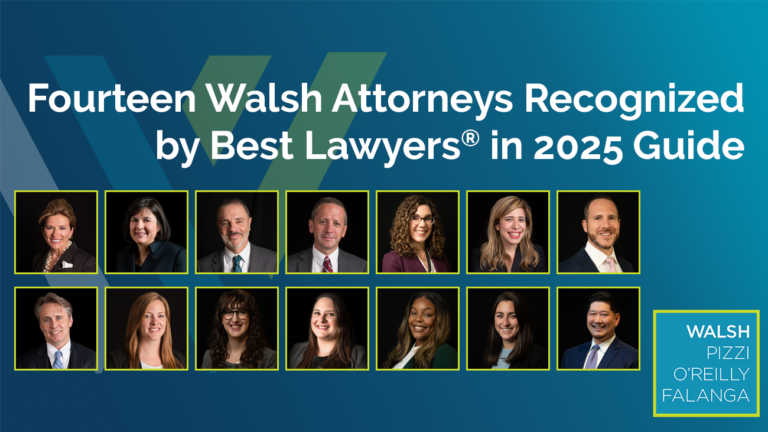
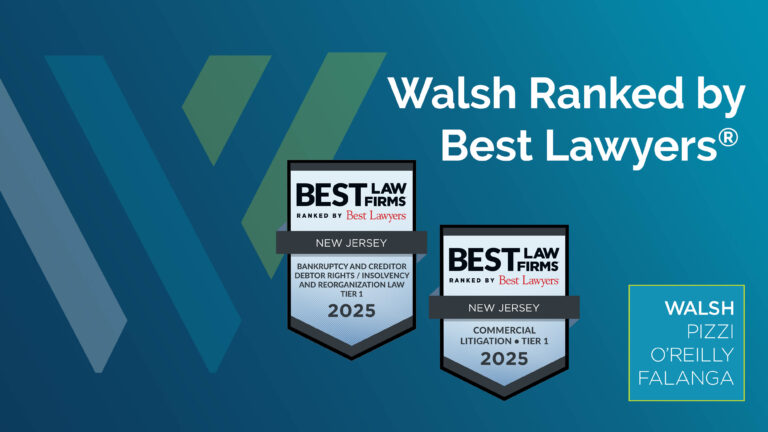
Nine Walsh Partners, Five Associates Recognized by Best Lawyers® in 2025 Guide

Nine Walsh Partners, Five Associates Recognized by Best Lawyers® in 2025 Guide 1300 731 Gabby Sully

NEWARK, N.J., August 15, 2024 – Walsh Pizzi O’Reilly Falanga LLP is proud to announce that Best Lawyers® has selected nine Walsh Partners for inclusion in the 2025 Edition of The Best Lawyers in America®.
Walsh Partners named as Best Lawyers® include:


Additionally, five associates have been included in the 2025 edition of Best Lawyers: Ones to Watch® in America.
Walsh Associates named as Ones to Watch® include:

  • Deirdre T. Cooney – Labor and Employment Law – Management and Litigation – Labor and Employment
  • Jessica K. Formichella – Commercial Litigation, Product Liability Litigation – Defendants, and Professional Malpractice Law
  • Jordynn E. Jackson – Litigation – Labor and Employment
  • Lauren R. Malakoff – Mass Tort Litigation / Class Actions – Defendants
  • Francis W. Yook – Commercial Litigation


Recognition by Best Lawyers® is based entirely on peer review, a consensus opinion of leading lawyers about the professional abilities of their colleagues within the same geographical area and legal practice area. The Best Lawyers in America® was first published in 1983 and publishes top legal talent in more than 70 countries around the world.

###

Federal Trade Commission Seeks to Ban Non-Competition Agreements

Federal Trade Commission Seeks to Ban Non-Competition Agreements 1300 731 Gabby Sully

On April 23, 2024, the Federal Trade Commission (“FTC”) issued a final rule that would ban nearly all non-competition agreements in the United States. While states have been actively regulating non-competes in recent years, this rule marks the first time that a federal standard will apply on a national level. This rule is to go into effect on September 4, 2024.

Key Provisions
The rule is broad and prohibits traditional non-competes – those that prevent workers from going to work for competitors. The rule redefines a “non-compete clause” as a term or condition of employment that prohibits a worker from, penalizes a worker for, or functions to prevent a worker from 1) seeking or accepting work in the U.S. with a different business where such work would begin after the conclusion of employment, or 2) operating a business in the U.S. after the conclusion of employment. Once the rule goes into effect, it will supersede all contrary state laws.

The rule requires employers to give notice that existing non-competes are no longer enforceable. Model notice language is included in the Rule and can be delivered by email or text message, or by delivering a paper notice by hand or mail. The notices must be sent before the effective date of the rule.

Who is Bound By This Rule?
Most employers will be subject to the rule when it goes into effect. Violations of the FTC Act may result in fines, penalties, and other injunctive relief. However, certain entities are exempt from the FTC’s jurisdiction under the FTC Act. These entities generally include certain financial institutions including banks, credit unions, savings and loans, some non-profit organizations, and air carriers. For purposes of the rule, “worker” is broadly defined as any natural person who worked or previously worked for another person. The worker may be an employee, independent contractor, intern, volunteer, apprentice, sole proprietor, minority owner, or any other natural person who provides services.

Categories Not Covered by the Rule (Not Banned)

  1. Senior Executives: This rule will allow existing non-competes with senior executives to remain but will ban new non-competes with senior executives. The rule defines “senior executive” as a worker earning more than $151,164 who is in a “policy-making position.” A “policy-making position” includes a firm’s president, chief executive officer or the equivalent, any other officer with “policy-making authority,” and any other natural person with “policy-making authority” similar to that of an officer. “Policy-making authority” entails the “final authority to make policy decisions that control significant aspects of a business entity or common enterprise” but does not include “authority limited to advising or exerting influence over such policy decisions or having final authority to make policy decisions for only a subsidiary of or affiliate of a common enterprise.”
  2. Bona Fide Sale of a Business: There is a narrow exception allowing non-competes in certain “sale-of-business” agreements. This exception includes bona fide sales of a business, of a person’s ownership interest in a business, or of all or substantially all of a business’s operating assets.
  3. Prior Causes of Action: Causes of action that accrue before the rule’s effective date on September 4, 2024 are permitted to proceed.


The Latest Legal Challenges
On July 3, 2024, the Northern District of Texas, in Ryan LLC v. Federal Trade Commission, granted the plaintiff’s motion for a stay of the effective date and preliminary injunction of the FTC non-compete rule as applied to the Ryan LLC plaintiffs. While this preliminary injunction technically only applies to the plaintiffs and plaintiff-intervenors in the Ryan LLC case, analysts expect final injunction after adjudication on the merits to be nationwide, meaning that it would bar the FTC from enforcing the rule. In its decision and order, the court set forth that it expects to grant a final injunction after adjudicating the merits, which the court indicated it intends to conclude by August 30, 2024.

Ryan LLC is only one of several challenges to the rule. Additional challenges are pending in different courts, which may reach a resolution and other conclusions before Ryan LLC. This means another court may grant a nationwide preliminary injunction.

What Should Employers Do?

  1. Carefully follow whether the rule is enjoined and stay on top of the deadline for compliance if the rule remains.
  2. Conduct an audit of their existing agreements, analyze the potential impact of the new rule on the agreements, and weigh the costs and benefits of not revising agreements versus revising them before making any business decisions.
  3. Prepare a notice should the rule become effective by compiling a list of impacted current and former employees with relevant contact information.
  4. Consider alternatives to noncompete clauses. Employers should strategize other interest-protection methods that would achieve the same goals with less risk involved. This may include a properly tailored customer nonsolicitation or a confidentiality provision, if permitted by other local, state, and federal laws.
  5. Consider retention strategies in light of the rule against non-competes to reduce the number of employees exiting the company without a non-compete agreement. Key retention strategies might include more employee flexibility, better work-life balance, work from home availability, competitive compensation, and other benefits.
  6. Determine whether any impacted employees qualify for the “senior executive” description. Further evaluate whether there are “senior executives” who should sign non-competes prior to the Rule’s effective date.
  7. DO NOT send notices right away; monitor the progress of the legal challenges.


For any questions on the new FTC ban or to discuss strategies for addressing the potential upcoming non-compete ban, please contact Walsh’s Labor & Employment law practice group.


This article was authored by Walsh Pizzi O’Reilly Falanga LLP Summer Associate and Fordham University School of Law J.D. Candidate,  Alexandra Arleo.

Meet Walsh’s 2024 Summer Associates

Meet Walsh’s 2024 Summer Associates 1300 731 Gabby Sully

Alexandra Arleo is a rising 2L at Fordham University School of Law. Prior to law school, Alexandra was Citigroup’s Strategic Business Management Assistant Vice President. She earned her bachelor’s degree in economics with minors in political science and gender and women’s studies from Villanova University.

What made you want to pursue law as a career?
I always knew I wanted to work in a field where I could directly make an impact. I decided to pursue a law degree because I want a career where I can apply my critical thinking and writing skills to help others.

What’s your favorite part about working at Walsh?
The culture! Everyone has been so welcoming. Each attorney I have worked with has offered so much support and guidance to ensure I have a full grasp on the project at hand.

What are you looking forward to next semester?
As a rising 2L, I look forward to my upper-level classes this year! I am also looking forward to joining Fordham’s Urban Law Journal as a staff member. I hope to hone my legal writing and research skills that I can directly apply throughout my career.


Michael Asante-Appiah is a rising 3L at Seton Hall University School of Law. Michael was an Associate Editor on the Seton Hall Journal of Legislation and Public Policy, Volume 48. He earned his bachelor’s degree in political science from Purdue University, where he was the recipient of the 35th and 46th Academic and Service Awards by the Purdue Black Caucus of Faculty and Staff.

What made you want to pursue law as a career?
I wanted to pursue law as a career because I was intrigued by the challenge of the field and believed it would be a great opportunity to help people in times where they often feel the most vulnerable.

What’s your favorite part about working at Walsh?
My favorite part about working at Walsh is definitely the people. Everyone is so kind and open to discussing any possible issue. It has been a great experience so far.

What are you looking forward to upon graduating?
Upon graduating, I am excited to clerk for a judge and learn more about how the legal system works in practice.

Lauryn Kearney is a rising 3L at Rutgers Law School. During the 2023-24 semester, Lauryn was a part of the Editorial Staff for the Rutgers University Law Review. She is also a part of the school’s Minority Student Program. Lauryn earned her bachelor’s degree in history from Florida State University.

What made you want to pursue law as a career?
I wanted to work in a field that would allow me to help others in an intellectually stimulating way. That desire and my love of writing, research, and history made law an easy choice.

What’s your favorite part about working at Walsh?
Walsh is amazing. I get to explore many different areas of the law and learn how to “lawyer” from a group of talented individuals. Everyone, from the partners to the office staff, is welcoming, supportive, and available to answer my questions. I’ve learned and laughed so much this summer.

What are you looking forward to upon graduating?
Upon graduation, I look forward to beginning my clerkship with the Honorable Judge Hany Mawla of the Appellate Division. I cannot wait to learn about the inner workings of our New Jersey court system while simultaneously honing my writing and research skills.


Alex Storzillo is a rising 4L at Rutgers Law School’s Part-Time Program. Alex is a Senior Editor for the Rutgers University Law Review and a Teaching Associate for Legal Analysis Writing and Research Skills (LAWRS). During the 2022-23 semester, he was an Assignment Coordinator for the Courtroom Advocates Project. Alex is currently a charge paramedic at The Valley Hospital in Paramus and advanced cardiovascular life support instructor and paramedic with St. Joseph’s University Medical Center in Paterson. He received his bachelor’s in law and society from Ramapo College of New Jersey.

What made you want to pursue law as a career?
Although I haven’t taken the most direct route, law school has always been a long-term goal of mine. I’ve been a paramedic for the past ten years and was an EMT for four years before that. I was drawn to law because of the challenge and the level of creativity needed to solve legal issues. As a non-traditional student starting a second career, I believe my background in EMS, working under pressure and building relationships with people in their time of need makes me uniquely situated to succeed in such a challenging, yet rewarding profession.

What’s your favorite part about working at Walsh?
My favorite part about working at Walsh is the welcoming atmosphere and tangible legal experience I’ve gained. I’ve been assigned substantive work since day one, and truly feel like I am a part of the team. In just a short time I’ve had the opportunity to draft motions, observe court proceedings, and participate actively in the ins and outs of various cases. My opinions and input are valued, and each attorney is ready, willing, and able to answer questions I may have, no matter how small. The firm has a very collegial and collaborative atmosphere that makes me look forward to coming in every day.

What are you looking forward to in your next steps/future upon graduating?
I am entering my final semester of law school this Fall and am looking forward to graduating and beginning my second career. After graduation I hope to attain a job as an attorney and continue to hone my skills to become the best litigator and advocate for my clients I can be.

Walsh’s summer program is coordinated by partners Mariel L. Belanger and Caitlin P. Cascino. “It has been a pleasure welcoming Alexandra, Michael, Lauryn, and Alex to Walsh this summer. They have been an impressive group of aspiring lawyers who have enthusiastically tackled their assignments and engaged with members of the firm. We have made a concerted effort to expose our summer associates to multiple areas of the law through varied assignments with attorneys in a range of practice areas. This summer, our summer associates have had many invaluable opportunities to observe courtroom proceedings, depositions, and conferences. Walsh is committed to developing the next generation of attorneys through our summer associate program, and after spending the summer with Alexandra, Michael, Lauren and Alex, we have no doubt they will find great success in the legal profession.”

Walsh Attorneys featured in IADC Defense Counsel Journal’s New Federal Rule of Evidence Rule 702: A Circuit-by-Circuit Guide to Overruled “Wayward Caselaw”

Walsh Attorneys featured in IADC Defense Counsel Journal’s New Federal Rule of Evidence Rule 702: A Circuit-by-Circuit Guide to Overruled “Wayward Caselaw” 1300 731 Gabby Sully

Today, the Defense Counsel Journal, a law review of the International Association of Defense Counsel, published a circuit-by-circuit Guide to Overruled “Wayward Caselaw” concerning Rule 702 of the Federal Rules of Evidence. Rule 702 was revised in December 2023 for the first time in twenty-three years to address what the Advisory Committee on Evidence Rules identified as a pervasive problem of “wayward caselaw” in which federal courts had been “far more lenient about admitting expert testimony than any reasonable reading of the Rule would allow.”

Walsh’s Peter J. Pizzi and Christine P. Clark wrote the portion of the Guide addressing cases in the Third Circuit that strayed from the application of Rule 702 as intended when the Rule was originally drafted and even more so as the recent revisions to the Rule.

The Defense Counsel Journal has been continuously published by the IADC since 1934. Peter Pizzi is the incoming Editor.

Department of Labor: New Overtime Rule is Scheduled to Go into Effect on July 1, 2024

Department of Labor: New Overtime Rule is Scheduled to Go into Effect on July 1, 2024 1300 731 Gabby Sully

The Department of Labor (DOL or Department) promulgated a new rule that is to go into effect on July 1, 2024. The final rule updates and revises the regulations issued under section 13(a)(1) of the Fair Labor Standards Act (FLSA) implementing the exemption from minimum wage and overtime pay requirements for executive, administrative, and professional (EAP) employees. Revisions include increases to the standard salary level and the highly compensated employee total annual compensation threshold, and a mechanism that provides for the future updating of these earnings thresholds to reflect then-current earnings data.

Under the current law, salaried workers who are paid over $35,568 per year are exempt from the FLSA’s overtime regulations, meaning they are not entitled to overtime pay (one and one-half times their regular pay for working over 40 hours per week).  Under the new law, the salary threshold is increased to $43,888, meaning salaried workers who work over 40 hours per week and make less than $43,888 per year will be eligible for overtime pay. The Department will raise this threshold to $58,656 per year on January 1, 2025.

The rule will also increase the total annual compensation requirement for highly compensated employees (who are not entitled to overtime pay under the FLSA if certain requirements are met) from $107,432 per year to $132,964 per year on July 1, 2024, and then set it equal to $151,164 per year on January 1, 2025.

These thresholds will be automatically updated every three years to reflect earnings data and other market implications. The current duties tests or salary basis requirements as to how overtime should be calculated – time and a half in excess of 40 hours per week – have not been changed.

Potential Legal Challenges:
Two challenges to the DOL’s new rule have been filed in Texas federal courts. The nature of the challenges include:

    1. The rule is invalid because the salary increase is too large;
    2. The DOL lacks the authority to impose a threshold at all;
    3. Automatic updates to the salary thresholds are invalid because a notice and comment rule-making period must occur prior to each change;
    4. The DOL’s rulemaking does not comply with the Administrative Procedure Act (APA), which governs the process by which federal agencies develop and issue regulations; and
    5. Enforcing these rules infringes on states’ sovereignty.


How Employers Should Address This New Rule by Formatting a Plan:
At this time, the rule remains set to go into effect. Therefore, employers should consider compliance plans that include the following steps:

  1. Identify which employees are impacted by the rule to determine the total amount of employees that will be exempt
  2. Once it has been determined who is impacted, determine a response
    • Potential Response 1: Increase salaries to ensure employees remain exempt
      • Consideration: convert non-salary employment benefits into salaried pay to reach the salary threshold
    • Potential Response 2: Reclassify employees as non-exempt and pay those employees overtime
    • Potential Response 3: Implement an organization restructuring plan by increasing salaried pay for others while terminating employment of non-exempt employees to offset costs


Plan Considerations For Employers:
When considering options for addressing the new rule, employers should keep in mind that increasing salaries for a portion of employees may result in salary compression.  Additionally, reclassification of employment across an organization may lower overall employee morale.  Employers should always consider state laws during planning.  Given the pending challenges to the new rule, employers should think about implementing salary increases close to or on July 1 in the event this rule is placed on hold.

Department of Labor Recommendations for Communication to Employees on Changes:
The DOL recommends certain strategies for communicating these rule changes to employees.  For example, the DOL indicates that organizations should train newly non-exempt employees on internal time keeping systems. Organizations also should provide information on time keeping with respect to mealtimes, breaks, work hours, and use of personal devices while on the clock.  The DOL also recommends that organizations coordinate with their Human Resources teams to prepare materials such as FAQs to address employee questions and concerns related to the new rule.

For any questions on the new DOL rule or to discuss strategies for addressing the salary thresholds, please contact Walsh’s Labor & Employment law practice group.


This article was authored by Walsh Pizzi O’Reilly Falanga LLP Summer Associate and Fordham University School of Law J.D. Candidate,  Alexandra Arleo.

The Pregnant Workers Fairness Act – EEOC’s Final Rule in Effect

The Pregnant Workers Fairness Act – EEOC’s Final Rule in Effect 1300 731 Gabby Sully

The Pregnant Workers Fairness Act (PWFA) requires the federal government, as well as certain private, state, and local employers, to provide “reasonable accommodations” to a qualified employee’s or applicant’s known limitations related to, affected by, or arising out of pregnancy, childbirth, or related medical conditions, unless the accommodation would cause the employer an “undue hardship.” The PWFA went into effect on June 27, 2023. After a notice and comment period, the EEOC issued its final regulations to carry out the law and provide clarity on its broad interpretation of the PWFA.  The regulations went into effect on June 18, 2024.  Under the new regulations, employers’ obligations are expansive and go beyond what the Americans with Disabilities Act (ADA) requires for disabilities.

Who Is Covered?
The PWFA covers employers (as well as unions and employment agencies), employees, applicants, and former employees who are currently covered by: (1) Title VII of the Civil Rights Act of 1964; (2) the Congressional Accountability Act of 1995 and 3 U.S.C. § 411(c); (3) the Government Employee Rights Act of 1991 (GERA); or (4) section 717(a) of Title VII, which covers federal employees. Whoever satisfies the definition of an “employer” or “employee” under any of these laws is an employer or employee for purposes of the PWFA.

What Limitations Must Be Accommodated?
Employees or applicants may seek reasonable accommodations regarding limitations and medical conditions, such as miscarriage or stillbirth, migraines, lactation, and other pregnancy-related conditions.  Pregnancy and childbirth are defined broadly to include a current or past pregnancy, potential or intended pregnancy (such as infertility, fertility treatments, and the use of contraception), labor, and childbirth. An employee’s limitations need not be major or ongoing; minor and episodic needs and limitations must also be accommodated.

Examples of possible reasonable accommodations include:

  • Additional breaks to drink water, eat, or use the restroom to accommodate fatigue or breastfeeding needs
  • Time off for health care or prenatal care appointments
  • Time off to recover from childbirth or a miscarriage
  • Temporary reassignment to alternate locations to reduce work commute
  • Temporary suspension of certain job duties
  • Telework to minimize risk of diseases
  • Modification of equipment, uniforms, or devices


When Does an Employer Become Obligated to Offer Accommodations?
Once an employee makes “known” to their supervisor that they have a limitation related to pregnancy, childbirth, or a related medical condition and need a change in how they work, the employer is obligated to either provide an effective accommodation or communicate with the employee to identify one. An employee does not have to mention the law by name. Rather, an employee may simply voice a concern to trigger the obligation to accommodate. When considering the potential accommodations that can be provided, the new regulations only allow employers to request “reasonable documentation” for such requests when it is “reasonable under the circumstances.”

What Constitutes an “Undue Hardship”?
An employer may consider multiple factors to determine whether an accommodation would impose an undue hardship on an employer and its business.  According to the EEOC’s regulations, these factors can include:

  • The length of time that the employee will be unable to perform the essential function(s)
  • Whether there is work for the employee to accomplish
  • The nature of the essential function, including its frequency
  • Whether the employer has provided other employees in similar positions who are unable to perform the essential function(s) of their positions with temporary suspensions of those functions and other duties
  • Whether there are other employees, temporary employees, or third parties who can perform or be temporarily hired to perform the essential function(s) in question
  • Whether the essential function(s) can be postponed or remain unperformed for any length of time and, if so, for how long


If an employer concludes the requested accommodation is unduly difficult or expensive, then that employer must work with the employee to try to reach an alternate solution.

What Should Employers Do Now?
Employers should ensure their workplace policies and procedures comply with the PWFA and the EEOC’s new guidance:

    1. Employers should ensure that supervisors and managers are properly trained on the PWFA and the interactive process so that they know how to respond to a request for an accommodation.
    2. Managers should be prepared to understand the rights of applicants and workers who are pregnant, trying to become pregnant, recently gave birth, or who have miscarried.
    3. Employers must avoid retaliating against those who request a reasonable accommodation. The PWFA retaliation provision shares the protections and damages provisions under the Americans with Disabilities Act and Title VII.
    4. Management should also be made aware that the PWFA does not replace federal, state, or local laws that are more protective of workers affected by pregnancy, childbirth, or related medical conditions. For example, New York recently implemented paid leave for pregnant employees to attend doctors’ appointments, thereby expanding its paid sick time requirements up to an additional 20 hours.  And New Jersey employers are already subject to the provisions and obligations of N.J.S.A. 10:5-12(s).


For any questions on the new pregnancy-related laws and regulations, or to discuss strategies for accommodating pregnant workers, please contact Walsh’s Labor & Employment law practice group.


This article was authored by Walsh Pizzi O’Reilly Falanga LLP Summer Associate and Fordham University School of Law J.D. Candidate,  Alexandra Arleo.

Joseph L. Linares appointed as Co-Chair of Essex County Bar Association Judicial Selection Committee

Joseph L. Linares appointed as Co-Chair of Essex County Bar Association Judicial Selection Committee 1300 731 Gabby Sully

NEWARK, N.J. – Joseph L. Linares was appointed as Co-Chair of the Judicial Selection Committee of the Essex County Bar Association for the 2024-25 term. The appointment was made by recently installed ECBA President, James DiGiulio, effective June 1, 2024.

In his new role, Joe, alongside Co-Chair Henry Klingeman, will undertake the critical responsibility of vetting and evaluating nominees for potential judicial vacancies within Essex County. Their objective is to uphold the highest standards of integrity and competence in the selection process, ensuring that only the most qualified candidates are recommended for future judgeships.

Commenting on his appointment, Joe expressed his commitment to the task ahead, “I am honored to serve as Co-Chair of the Judicial Selection Committee at the ECBA. We are dedicated to upholding the principles of fairness and excellence in the selection of judicial candidates. Our goal is to contribute to the continued advancement of justice within Essex County.”

For more information on the Essex County Bar Association, click HERE.

Walsh Ranked in Chambers and Partners USA 2024 Guide

Walsh Ranked in Chambers and Partners USA 2024 Guide 1200 675 Gabby Sully

NEWARK, N.J. – Chambers and Partners USA 2024 Guide has recognized Walsh Pizzi O’Reilly Falanga LLP as a Leading Firm for the third consecutive year. Additionally, Chambers recognizes founding partners Liza Walsh and Stephen Falanga.

Liza Walsh has ranked as a Leading Lawyer in the Litigation: General Commercial – New Jersey category. Liza offers significant experience representing corporations in an array of disputes, including IP litigation and class actions. This is her seventh year ranked.

Stephen Falanga was recognized as a top lawyer in Bankruptcy/Restructuring – New Jersey. He is highlighted for his ability to advise debtors and creditors on a range of matters. He is renowned for his ability to handle Chapter 11 cases. This is his third year ranked.


Per Committee on Attorney Advertising Ethics Opinion 42, this advertising is not approved by the New Jersey Supreme Court.

Liza M. Walsh Recognized by Essex County Bar Association with Federal Practice Award

Liza M. Walsh Recognized by Essex County Bar Association with Federal Practice Award 1299 638 walsh.law
On May 6, Liza M. Walsh was recognized by the Essex County Bar Association with the Federal Practice Award at its 2024 Annual Installation and Awards Reception. The Federal Practice Award is presented to attorneys who have made significant contributions to the practice of law and the legal profession in Federal law.


Walsh Welcomes Priscilla E. Savage

Walsh Welcomes Priscilla E. Savage 2560 1338 walsh.law

NEWARK, N.J., – Walsh Pizzi O’Reilly Falanga LLP welcomes Priscilla E. Savage to the firm! Priscilla will be focusing her practice on management-side employment and labor litigation, as well as commercial litigation.

Priscilla served as a Judicial Law Clerk to the Honorable Douglas M. Fasciale, Associate Justice, Supreme Court of New Jersey, during his tenure in the Appellate Division. Prior to joining the firm, Priscilla was an associate at a mid-size law firm.

In 2020, Priscilla earned her J.D. from Seton Hall University School of Law, where she served as the Business and Publication Editor for the Seton Hall Legislative Journal. She earned a B.A., summa cum laude, in Political Science and Planning & Public Policy from Rutgers University. While at Rutgers, Priscilla was a Lloyd C. Gardner Fellow and an Eagleton Undergraduate Associate. She is a proud Douglass Residential College alumna.